ISO 9001:2015
Certified Quality Management
SECP Registered
Pvt Ltd Company (Reg. 2025)
British Council
Certified Counselors
25+ Years
CEO Personal Experience
High Visa Success Ratio
China X1 Student Visa Track Record
29 Universities
PMDC-Approved
QUICK ANSWER
MBBS in China for Pakistani students is a 5+1 year medical degree (5 years study + 1 year internship) at PMDC-approved Chinese universities. MTZ places students at 29 PMDC-recognised universities — 13 MOE-listed (English-medium MBBS) and 16 non-MOE listed (bilingual MBBS). Annual total cost ranges PKR 7.3L–15L depending on university tier. Recognised by PMDC, WDOMS, WFME and ECFMG — eligible for USMLE, PLAB, AMC, MCCQE, DHA and GCC licensing pathways. WhatsApp MTZ for a free eligibility check.
Duration
5 years study + 1 year internship
Medium
English (13 MOE universities) or Bilingual (16 non-MOE)
Intakes
September (main) + March (smaller)
Annual Total Cost
PKR 7.3L–15L (tuition + hostel + basic living) [VERIFY]
Universities
29 — All PMDC approved
Recognition
PMDC · WDOMS · WFME · ECFMG
Fee range is a placeholder. Replace with MTZ-verified 2026 PKR figures before publish.
MBBS in China for Pakistani Students — Complete Road Map 2026
A clear, end-to-end pathway from your FSc result to practising medicine — in Pakistan, the Gulf, the UK, the US, Australia or Canada. Every Pakistani MBBS student MTZ places follows the same nine stages.
1
Your FSc Pre-Medical result (60%+)
Your academic foundation. Premium-tier universities want 70%+; affordable-tier universities accept 60%. Different universities have different cut-offs.
2
Free MTZ eligibility check on WhatsApp
Send your FSc marks and budget on WhatsApp. We respond within 24 hours with the PMDC-approved universities (MOE-listed or non-MOE) that match your profile.
3
Your shortlist of 3–5 universities
Fees in PKR, intake calendar, city profile, hostel options, MOE vs non-MOE trade-off. You and your parents decide together — no pressure from MTZ.
4
We prepare your full application
Transcripts, passport, medical fitness certificate, police clearance. Handled by our documentation team in Islamabad or Lahore.
5
Admission letter + JW202 form arrives
Issued by your chosen Chinese university, typically within 2–8 weeks. JW202 follows shortly.
6
Your X1 student visa
MTZ prepares your X1 visa file, briefs you for the embassy interview, and submits through Islamabad or Lahore. Decisions in 4–10 working days.
7
5 years MBBS + 1 year internship
English (MOE universities) or Bilingual (non-MOE — HSK-4 required in Year 1). Internship at Class-A teaching hospital.
8
You choose your licensing pathway
Pakistan (NLE) or international: USMLE, PLAB, AMC, MCCQE, DHA, GCC.
9
You begin your medical career
Practise in Pakistan, the Gulf, the UK, the US, Australia or Canada.
Why Pakistani Students Choose MBBS in China
MBBS in China has become the most credible, affordable and globally portable pathway to a recognised medical degree for Pakistani students. The combination of 29 PMDC-approved universities (13 MOE-listed English-medium + 16 bilingual), modern Class-A teaching hospitals, and explicit licensing pathways into the US, UK, Australia, Canada, UAE and GCC is what makes it different from MBBS programmes elsewhere.
29 PMDC-Approved Universities
All 29 universities are on the current PMDC recognised foreign-institutions list. We check the PMDC list monthly and notify families immediately if status changes.
English or Bilingual — Your Choice
13 MOE-listed universities offer fully English-medium MBBS. 16 bilingual universities offer the same degree at lower cost — students reach HSK-4 in Year 1.
Globally Portable Degree
WDOMS listed and WFME standards — your degree is usable for USMLE (USA), PLAB (UK), AMC (Australia), MCCQE (Canada), DHA (UAE), and GCC licensing.
Affordable in PKR
MBBS in China costs roughly PKR 50L–80L total over six years. A Pakistani private medical college MBBS costs PKR 1.2 Cr–2 Cr. The same degree in the UK or Caribbean exceeds PKR 4 Cr. Real numbers, your calculations.
Modern Teaching Hospitals
Each of the 29 universities operates a large Class-A affiliated hospital for clinical training. Specialist hospitals are common (cardiology, oncology, paediatrics).
Strong Pakistani Community
Established Pakistani Students Association on every campus. MTZ connects new arrivals with senior Pakistani students for mentorship from day one.
Global Recognition & International Licensing Pathways
MTZ places students only at Chinese medical universities whose MBBS programmes are recognised by the world’s major medical accreditation bodies — and whose graduates are eligible for the major international medical licensing exams. Your degree is portable from day one.
Is your degree recognised?

PMDC
Pakistan Medical & Dental Council
All 29 universities are PMDC-recognised. Required for NLE and PMDC registration on return.

WDOMS
World Directory of Medical Schools
FAIMER/WFME joint global directory — prerequisite for ECFMG.

WFME
World Federation for Medical Education
Programme meets globally agreed quality standards.

ECFMG
Educational Commission for Foreign Medical Graduates
Required certification for US residency via USMLE. Confirmed for MOE-listed; subject to verification for non-MOE.
Where can you practise?


UAE & GCC
Licensing exam: DHA · MOHAP · DOH · SLE · QCHP · KMOH · NHRA · OMSB
Emirate and country-specific licensing
Licensing eligibility is determined by each medical board at the time of application and may involve additional steps (e.g. supervised clinical practice, language tests, document attestation). MTZ guides students through the eligibility map but does not guarantee licensing outcomes.
PMDC Recognition for MBBS in China — The Direct Answer
Yes — MBBS degrees from PMDC-approved medical universities in China are valid in Pakistan, subject to PMDC’s current rules. All 29 universities where MTZ places students are on the PMDC’s current recognised list of foreign medical institutions. After graduation, Pakistani students sit the National Licensing Examination (NLE) — a standard requirement for all foreign medical graduates returning to Pakistan, including those from the UK, Australia and the Caribbean.
Before you finalise any university, verify three things on the official PMDC website (PMDC):
🔵 1- The university appears on the current foreign-recognition list.
🔵 2- The specific MBBS programme (English-medium or bilingual) is the one PMDC recognises
🔵 3- The intake year (2026-27) is within PMDC’s current acceptance window
PMDC rules are regulatory and may change. MTZ tracks PMDC updates monthly and notifies any enrolled student or family if a university’s status changes — even mid-MBBS.
MBBS in China Eligibility for Pakistani Students
Eligibility for MBBS in China for Pakistani students is straightforward when planned ahead. Baseline criteria are below; exact thresholds vary between universities and between MOE-listed and non-MOE listed institutions. Our free eligibility check matches your profile to current university-specific cutoffs.
Eligibility checklist
✓ Age: 17–25 at admission (some universities accept up to 28)
✓ Academic: FSc Pre-Medical (or equivalent) with minimum 60–70% — varies by university tier; MOE-listed typically expect 65–70%+
✓ MDCAT: PMDC’s current MDCAT policy for students going abroad applies. Confirm from PMDC’s official website. [VERIFY against current PMDC notification]
✓ English proficiency: Most universities accept FSc English; IELTS / TOEFL required only at a few elite MOE universities (Zhejiang, Fudan, Tianjin Medical, Tongji)
✓ Chinese language: Not required at admission for any of the 29 universities. Non-MOE bilingual universities require HSK-4 to be reached during Year 1
✓ Health: Medical fitness certificate including hepatitis B/C screen, HIV test, chest X-ray
✓ Documents: Valid passport (18+ months validity), FSc transcripts, matric & intermediate certificates, police clearance, 4 passport photos
What disqualifies you
We tell you honestly in your free eligibility check — before you commit to anything.
❌ 1– FSc Pre-Medical below 60%
❌ 2– A criminal record
❌ 3– Failure to clear the medical fitness check (active TB, untreated hepatitis B/C, HIV in some cases)
❌ 4– A passport with less than 18 months validity at intake date
Age above 25 at admission for most universities (above 28 disqualifies all)
MOE Listed vs Non-MOE Listed Universities — Which Suits You?
The 29 PMDC-approved Chinese medical universities where MTZ places Pakistani students split into two categories. Understanding the difference is the single most important decision a Pakistani family makes after committing to MBBS in China.
| Factor | MOE Listed (13 universities) | Non-MOE Listed (16 universities) |
| Medium of instruction | English throughout the MBBS | Bilingual — Year 1 Chinese language + clinical years mixed |
| Chinese language (HSK-4) | Submitted before graduation only | Must pass HSK-4 in Year 1 to progress |
| Admission letter wording | “MBBS in English” (explicit) | “Clinical Medicine — Bilingual” |
| Annual total cost (PKR) | PKR 12L–15L typically | PKR 7.3L–11L typically |
| Pakistan recognition (PMDC) | ✅ All recognised | ✅ All recognised |
| WHO / WDOMS listing | ✅ All listed | ✅ All listed |
| USA — USMLE / ECFMG | ✅ Confirmed eligible | Subject to ECFMG case-by-case verification |
| UK — PLAB / UKMLA | ✅ Eligible | ✅ Eligible |
| Australia — AMC | ✅ Eligible | ✅ Eligible |
| Canada — MCCQE | ✅ Eligible | ✅ Eligible |
| UAE — DHA / MOHAP / DOH | ✅ Eligible | ✅ Eligible |
| GCC — SLE / QCHP / KMOH / NHRA / OMSB | ✅ Eligible | ✅ Eligible |
| India — NMC | ✅ Yes | ❌ No |
| Bangladesh — BMDC | ✅ Yes | ❌ No |
| Typical Pakistani student | FSc 65%+ aiming for USA/UK after MBBS | FSc 60%+ on tighter budget, comfortable with Chinese language commitment |
| MTZ recommendation | First-choice for maximum international portability | Solid PMDC + global pathway with budget advantage |
NMC India / BMDC Bangladesh apply to those countries’ students only. Pakistani students are unaffected by NMC/BMDC — PMDC recognises both MOE and non-MOE listed universities.
29 PMDC-Approved Chinese Medical Universities — Where MTZ Places Pakistani Students
All 29 universities below are PMDC-recognised and WHO / WDOMS-listed. The list is divided by Ministry of Education (MOE) status — 13 universities are MOE-listed with English-medium MBBS, and 16 are non-MOE listed with bilingual MBBS. Click any university card for its detailed page covering fees in PKR, intake calendar, hostel details, distinguishing features and admission timeline.
MOE 2026–27 Listed — English-Medium MBBS — 13 Universities



Non-MOE Listed — Bilingual MBBS — 16 Universities — PMDC recognised — HSK-4 required in Year 1



MBBS in China Fees in Pakistani Rupees — Annual Range
MBBS in China fees in Pakistani rupees vary by university tier (Premium / Standard / Affordable), MOE-listed status (English vs Bilingual), city, and hostel category. The figures below are annual ranges for tuition, hostel and basic living costs combined. Exact PKR figures for any specific university among the 29 are published on that university’s dedicated page and confirmed in writing during your free MTZ consultation.
Before you read the fees: every PKR figure MTZ shares is in writing. MTZ Global Visa Consultants Pvt Ltd is SECP-registered, ISO 9001:2015 certified, and operates from physical offices in Islamabad (G8 Markaz) and Lahore (Gulberg III). Our counselors are British Council certified. No phone-call fees. No surprise add-ons.
| Tier | Example Universities [VERIFY] | Status | Tuition + Hostel / yr | Living / yr | Total / yr |
|---|---|---|---|---|---|
| Premium | Nanjing Medical, Zhengzhou, Jiangsu, Qingdao, Xiamen, Wenzhou Medical, Dalian Medical | MOE-Listed (English) | PKR 9L–12L | PKR 3L–4L | PKR 12L–15L |
| Standard | Fujian Medical, Ningbo, Kunming Medical, Jinzhou Medical, Southwest Medical, Shihezi, Binzhou Medical, Yangtze | Mostly MOE-Listed | PKR 6L–9L | PKR 2L–3L | PKR 8L–11L |
| Affordable | Hebei North, Hubei Minzu, Shihezi, Yichun, Wuhan UST, Shandong Second Medical, Gannan, Xinxiang, Shenyang Medical College, Zhejiang Chinese Medical, Jinggangshan, Youjiang, Hubei Arts & Science, Jianghan | Non-MOE Listed (Bilingual) | PKR 5L–7L | PKR 2L–3L | PKR 7.3L–9L |
Fees vary by intake year, hostel category, RMB-PKR exchange rate, and university scholarship eligibility. Rather than publishing outdated figures, MTZ confirms exact PKR fees, payment schedule and any applicable discounts in your free consultation — based on the current exchange rate and the specific intake you are applying for. All figures are documented in writing before any payment is made.
MBBS in China vs Private Medical College in Pakistan — Side-by-Side
Beyond Pakistan’s private medical colleges, three destinations dominate the Pakistani parent’s “where to send my child for MBBS” decision: China, Russia, Kyrgyzstan. Below is the honest comparison — MTZ places students in China only, but families should know how the three destinations compare on the metrics that matter.
| Factor | MBBS in China (MTZ’s 29) | MBBS in Russia | MBBS in Kyrgyzstan |
|---|---|---|---|
| Total 6-year cost (PKR) | 50L–80L | 40L–60L | 30L–45L |
| PMDC recognition | ✅ Yes (all 29 universities) | ✅ Yes (limited list) | ✅ Yes (limited list) |
| WHO / WDOMS listing | ✅ All 29 listed | ✅ Most listed | Mixed |
| ECFMG / USMLE | Eligible — confirmed for MOE-listed | Subject to verification | Subject to verification |
| Teaching medium | English (13 MOE) or Bilingual (16 non-MOE) | English / Russian mix | English / Russian mix |
| Class-A affiliated teaching hospitals | ✅ Standard at all 29 | Mixed | Limited |
| Pakistani student community | Large, established (decades) | Medium | Growing |
| Visa process from Pakistan | X1 student visa (4–10 working days) | Russian student visa (variable, 30+ days) | Kyrgyz student visa (variable) |
| Geopolitical stability (2026) | Stable | Volatile (war-related) | Stable |
| Modern campus infrastructure | High — China invested heavily 2000-2025 | Mixed | Limited |
| Recognition by US/UK boards | Strong | Mixed | Limited |
| MTZ recommendation | ✅ Our specialism — 29 universities | Not currently a service | Not currently a service |
MTZ does not place students in Russia or Kyrgyzstan. This comparison is provided for transparency — so Pakistani families can make an informed decision. If your child’s path is genuinely better served by Russia or Kyrgyzstan, we will tell you honestly during your free consultation.
MBBS in China vs Russia vs Kyrgyzstan — Compared for Pakistani Families
The two most common choices for Pakistani families who do not get a government medical college seat: MBBS at one of the 29 PMDC-approved Chinese universities, or MBBS at a Pakistani private medical college. Both produce a PMDC-recognised MBBS. Both require NLE. The difference is cost, global portability and admission difficulty.
| Factor | MBBS in China (one of MTZ’s 29) | Pakistani Private Medical College |
|---|---|---|
| Total 6-year cost | PKR 50L–80L all-in | PKR 1.2 Cr – 2 Cr (tuition alone) |
| PMDC recognition | ✅ Yes — all 29 PMDC-recognised | ✅ Yes |
| WDOMS / WFME / ECFMG | ✅ Yes — globally portable | Limited — primarily Pakistan recognition |
| US licensing (USMLE) | Eligible via ECFMG (MOE-listed); subject to verification (non-MOE) | Eligible but weaker school-level US transition support |
| UK licensing (PLAB / UKMLA) | Eligible | Eligible |
| Teaching language | English (13 MOE universities) or Bilingual (16 non-MOE) | English / Urdu mix |
| Pakistan return — NLE | Required | Required |
| Internship | At Chinese university’s Class-A affiliated hospital | At Pakistani teaching hospital |
| Admission threshold | FSc 60–70% (tier dependent) | FSc 80%+ with high MDCAT score |
| Seat availability | Open intake September + March | Highly competitive |
| Parent communication | MTZ liaises 6 years — Islamabad / Lahore office on call | Direct |
| MBBS in China advantage | Global portability + cost + open seats | Proximity to home + familiar language |
Both routes lead to the same NLE if practising in Pakistan. The trade-off is cost and global mobility versus proximity to home. We discuss this openly in your free consultation.
MBBS in China Application Timeline — From Your FSc Result to Campus
The MBBS admission process from Pakistan to China runs in clear monthly stages. The full journey takes 2–5 months from first WhatsApp message to first day on campus, depending on intake, document readiness and embassy slots.
| Month ⬇ | What happens |
|---|---|
| 🔵 Month 0 (FSc result day) | You WhatsApp your marks. Free MTZ eligibility check returned within 24 hours. We tell you which of the 29 universities (MOE or non-MOE) match your profile. |
| 🔵 Month 1 | University shortlist of 3–5 universities confirmed. Application submitted through MTZ. |
| 🔵 Month 1–3 | Admission letter and JW202 form arrive from your chosen university. |
| 🔵 Month 3–4 | X1 visa file prepared. Embassy interview rehearsed. Decision in 4–10 working days. |
| 🔵 Month 4–5 | Pre-departure briefing at Islamabad or Lahore office. Airport pickup arranged in China. |
| 🔵 Month 5 / Sep or Mar | First day on campus. Hostel handover. Pakistani Students Association introduction. Registration support for first 30 days. |
Full step-by-step guide:
How to Apply for MBBS in China from Pakistan →
Life as a Pakistani MBBS Student in China

Safety
Chinese university campuses are routinely rated among the world’s safest. Pakistani students report low-crime cities, well-monitored campuses, gated hostels and 24-hour security. MTZ’s Islamabad and Lahore offices are reachable 24/7 in genuine emergencies.
Halal Food
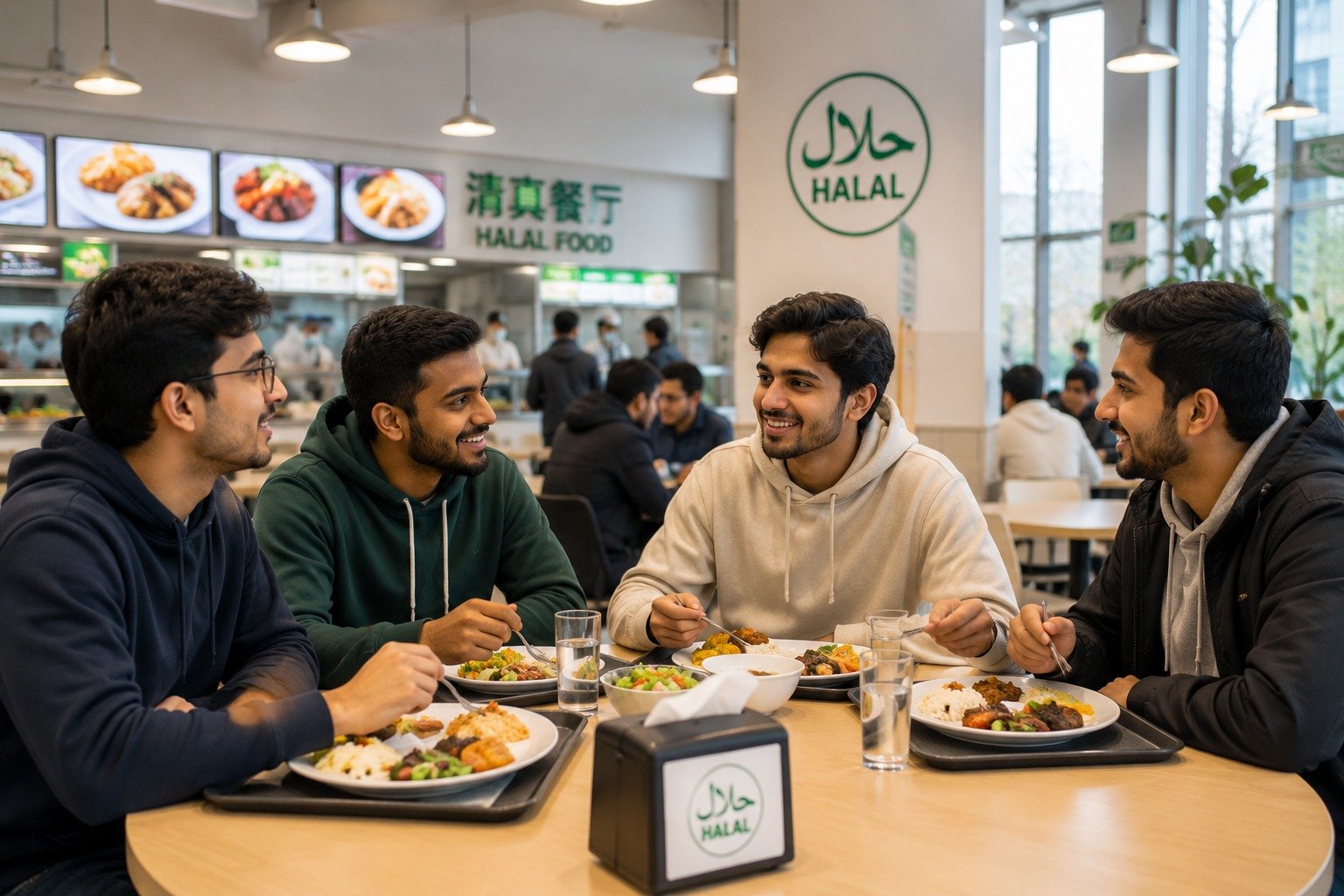
Halal food is widely available — Muslim student canteens on most campuses, Uyghur and Hui-Muslim restaurants in Xi’an, Lanzhou, Kunming, Shenyang and Wuhan, halal-certified outlets and Pakistani-run restaurants.
Female Hostels
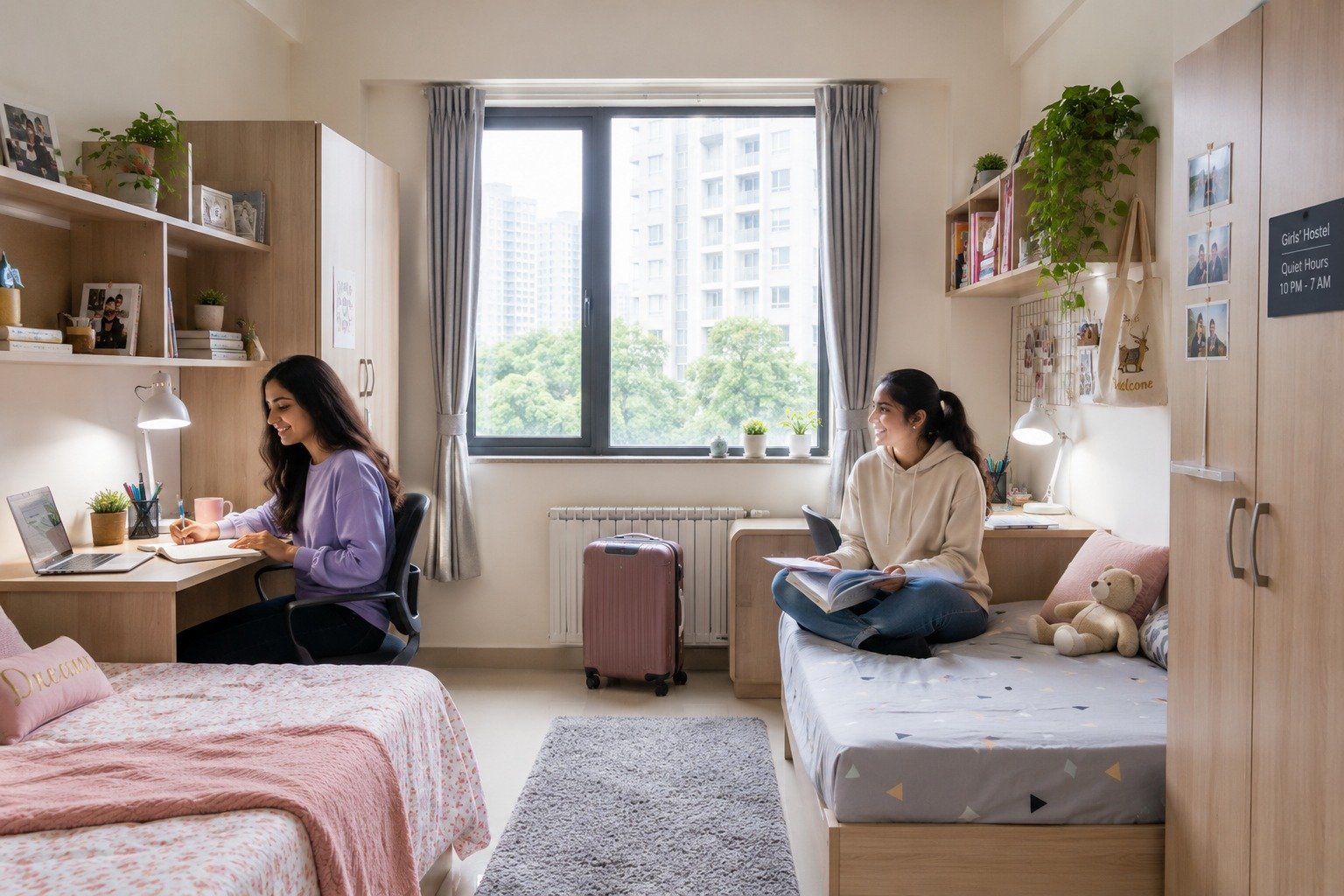
Most of the 29 universities offer girls-only floors or blocks, female warden, separate hostel entry, and 24-hour CCTV. MTZ shares photographs of the specific female hostel before you sign.

Pakistani Community
Pakistani Students Association on every of the 29 campuses. Named senior students mentor new arrivals — airport pickup, hostel handover, SIM, first-week orientation.

Weather & Clothing
Northern campuses (Liaoning, Shandong, Hebei) have cold winters (−5°C to −15°C). Southern campuses (Fujian, Yunnan, Sichuan, Guangxi) have mild winters. MTZ briefs you on what to pack.
Cost of Living
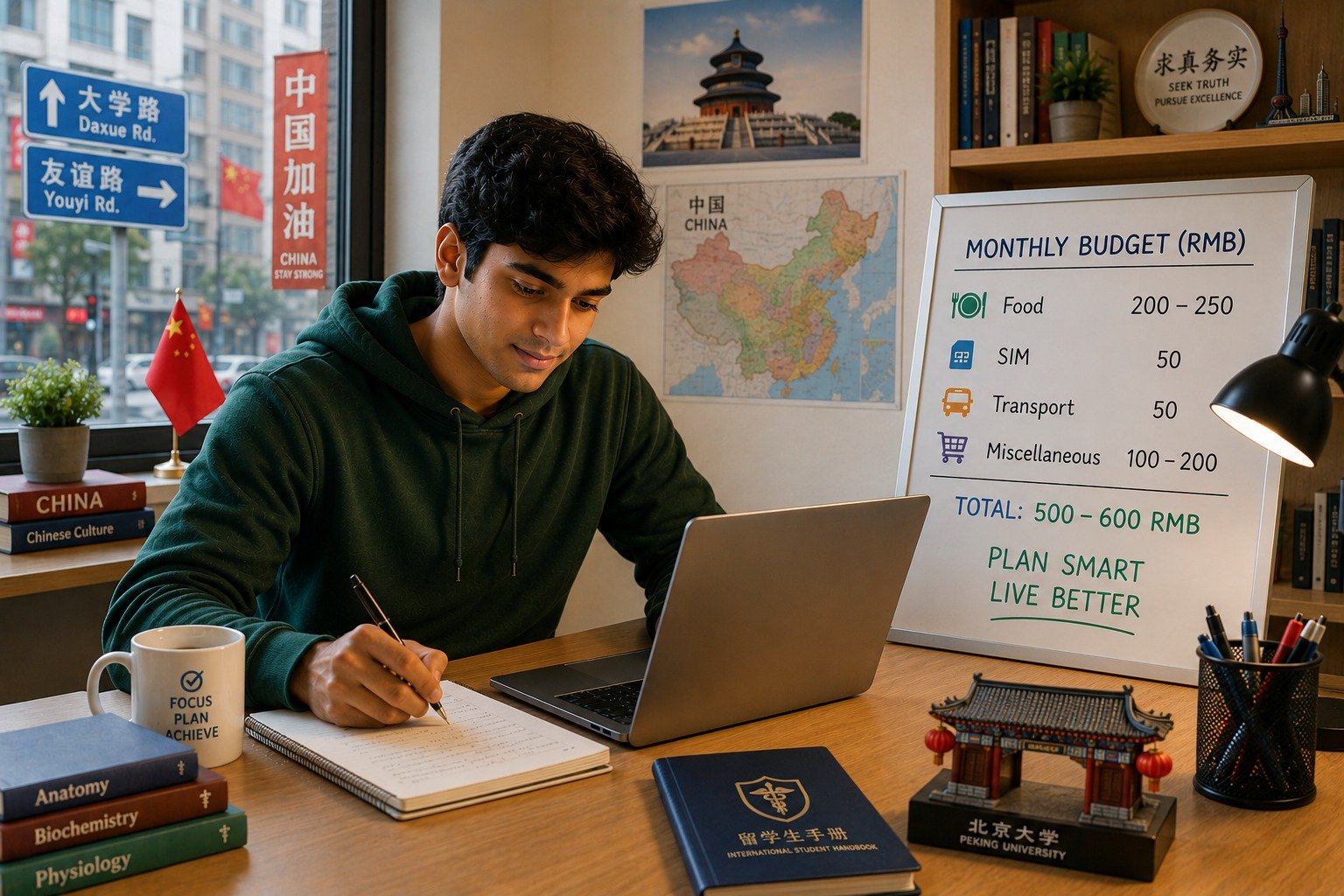
Realistic monthly spend in RMB: food RMB 800–1,200, SIM RMB 50–100, transport RMB 100, miscellaneous RMB 400. Approximate total: PKR 50,000–80,000/month at current exchange rates [VERIFY].
A Note on Scholarships for MBBS Students in China
A Note on Scholarships for MBBS Students in China
Some partner universities offer merit-based awards to high-performing MBBS students from their second year, based on academic performance — these are the university’s independent decisions and are not guaranteed at admission. MTZ Global Visa Consultants does not assure or guarantee scholarships for MBBS study in China. For fully funded MS and PhD scholarships, see our Global Scholarships hub.
Most Pakistani students enter MBBS in China as self-funded. The Chinese Government Scholarship (CSC) is highly competitive and rarely awarded for first-year MBBS — it is realistic for postgraduate study (MS, PhD) rather than undergraduate medicine.
What MTZ will do for you on scholarships:
1- Identify which of the 29 universities offer Year-2 merit awards based on first-year academic results
2- Tell you what the cut-off for each award is
3- Help you position your application for first-year scholarship eligibility
4- Warn you upfront if a university advertises scholarships that historically rarely materialise
We will not promise a scholarship at admission. We will help you earn one once you arrive.
China X1 Student Visa from Pakistan — What You Need
Once your admission letter and JW202 form arrive, MTZ handles your X1 student visa application through the Chinese Embassy in Islamabad or the Consulate in Lahore. Typical processing time: 4–10 working days.
Documents required (left column — MTZ prepares everything):
The embassy interview
A short 5–10 minute conversation. MTZ rehearses it with you the day before. Most-asked questions: Why this university? Who is funding your studies? When will you return to Pakistan?
Visa rejection — what happens
Visa rejection is rare with a properly prepared file. If due to MTZ’s file preparation, we resubmit at no additional fee. If due to applicant-side issues (incomplete documents, withheld information), we appeal and resubmit at cost. Our full refund and reapplication policy is published on the contact page — no hidden conditions.
After Your MBBS — Practice Pathways for Pakistani Doctors
On completion of your 5+1 year MBBS at any of MTZ’s 29 universities, you are eligible to apply for medical licensing in multiple jurisdictions. Below is a summary of the pathways most relevant to Pakistani graduates, with realistic timelines from MBBS graduation to first licensed practice.
| Destination | Exam | Brief description | Typical timeline post-MBBS |
|---|---|---|---|
| Pakistan | NLE (PMDC) | Mandatory licensing exam for Pakistan practice. PMDC registration follows. | 6–12 months prep + exam |
| USA | USMLE (via ECFMG) | Three-step exam. Leads to US residency match. Requires ECFMG certification. | 18–36 months (Step 1, 2 CK, 3 + match) |
| UK | PLAB / UKMLA | GMC’s licensing pathway. PLAB 1 (MCQ) + PLAB 2 (clinical). UKMLA replacing PLAB. | 12–18 months |
| Australia | AMC | MCQ + clinical exam. Leads to AHPRA registration. | 12–24 months |
| Canada | MCCQE | Part I (CDM) + Part II (OSCE). Provincial residency match. | 18–30 months |
| UAE | DHA / MOHAP / DOH | Emirate-specific — Dubai (DHA), Abu Dhabi (DOH), Northern Emirates (MOHAP). | 3–6 months |
| Saudi Arabia | SLE (SCFHS) | Saudi Licensing Exam. High demand for Pakistani-origin doctors. | 6–12 months |
| Qatar | QCHP | Qatar Council for Healthcare Practitioners — primary source verification + exam. | 6–12 months |
| Kuwait / Bahrain / Oman | KMOH / NHRA / OMSB | Country-specific GCC routes. | 6–12 months |
Licensing eligibility is determined by each medical board at the time of application and may involve additional steps. MTZ guides students through the eligibility map but does not guarantee licensing outcomes.
Where MTZ MBBS Alumni Are Now

Dr. [Name]
MBBS [University], [Year]
[Current status, e.g., USMLE Step 3 cleared]
Dr. [Name]
MBBS [University], [Year]
[Current status, e.g., USMLE Step 3 cleared]
Dr. [Name]
MBBS [University], [Year]
[Current status, e.g., USMLE Step 3 cleared]
Real graduates. Real licensing. Real practice. Names and details verifiable on request through MTZ Islamabad office.
Frequently Asked Questions — MBBS in China for Pakistani Students
Yes — but only from PMDC-listed universities. That is why MTZ places students only at PMDC-recognised institutions. All 29 universities where MTZ places Pakistani students are on the current PMDC recognised list. After graduation you sit the National Licensing Examination (NLE) administered by PMDC, a standard requirement for all foreign medical graduates returning to Pakistan, including those from the UK, Australia and the Caribbean.
MTZ’s 29 universities split into two categories. 13 are MOE-listed (English-medium MBBS, admission letters say “MBBS in English”, typically PKR 12L–15L per year). 16 are non-MOE listed (bilingual MBBS, HSK-4 Chinese required in Year 1, typically PKR 7.3L–11L per year). Both are PMDC-recognised. Both let you sit NLE, PLAB, AMC, MCCQE, DHA. The MOE-listed universities are confirmed for USMLE/ECFMG; non-MOE are subject to verification. MTZ helps you choose based on your budget and your career destination.
Most English-medium MBBS programmes for international students are 5 years of study followed by 1 year of clinical internship — a total of 6 years. Some non-MOE bilingual universities use a 1-year Chinese foundation followed by 5 years MBBS (still 6 years total).
Baseline eligibility: age 17–25 at admission, FSc Pre-Medical (or equivalent) with 60–70% minimum (varies by tier — MOE-listed typically expect 65–70%+), valid passport with 18+ months validity, English proficiency (most universities accept FSc English without IELTS), and a medical fitness certificate. Specific university cutoffs are confirmed during your free MTZ eligibility check.
PMDC’s MDCAT policy for students going abroad has changed in recent years and remains subject to regulatory updates. The current PMDC position is summarised in our dedicated article (link below). Always confirm the latest status directly from PMDC’s official website at pmdc.pk before finalising your application.
Annual fees fall into three tiers. Premium-tier universities (MOE-listed, English-medium): PKR 12L–15L. Standard-tier: PKR 8L–11L. Affordable-tier (mostly non-MOE bilingual): PKR 7.3L–9L. Exact figures for your chosen university are confirmed in writing in your free MTZ consultation, based on the current RMB-PKR exchange rate.
MTZ-placed graduates from PMDC + WDOMS + WFME + ECFMG-recognised universities are eligible to pursue medical licensing in Pakistan (NLE), the USA (USMLE), the UK (PLAB / UKMLA), Australia (AMC), Canada (MCCQE), the UAE (DHA / MOHAP / DOH), and the GCC (SLE in Saudi Arabia, QCHP in Qatar, KMOH in Kuwait, NHRA in Bahrain, OMSB in Oman). Each pathway has its own preparation requirements. MOE-listed universities have confirmed ECFMG/USMLE eligibility; non-MOE listed universities’ ECFMG status is subject to case-by-case verification.
Some partner universities offer merit-based awards to high-performing MBBS students from their second year, based on academic performance — these are the university’s independent decisions and are not guaranteed at admission. MTZ does not assure or guarantee scholarships for MBBS study in China. For fully funded MS and PhD scholarships, see our Global Scholarships hub.
Yes. Chinese university campuses are generally very safe — gated entry, on-campus hostels, female-only blocks or floors, female warden, and 24-hour security are standard at all 29 universities where MTZ places students. Pakistani female students have been studying MBBS in China for decades. MTZ connects every new student with the Pakistani Students Association on campus, and parents have our Islamabad / Lahore office numbers for any concerns throughout the programme.
Two intakes per year. The main September intake runs late August to mid-September with applications open January to June, and gives you access to all 29 MTZ universities. A smaller March intake runs late February to mid-March with applications open August to December, with around 14 universities accepting March intake students. September is always preferred.
Six monthly stages: free WhatsApp consultation (Month 0), university shortlist + application (Month 1), admission letter + JW202 form (Months 1–3), X1 student visa with embassy interview prep (Months 3–4), pre-departure briefing + airport pickup (Months 4–5), and arrival + 30-day registration support (Month 5). Total time: 2–5 months from enquiry to campus.
Yes. Every university has Muslim student canteens or nearby halal-certified outlets. Cities with larger Muslim populations — Xi’an, Lanzhou, Kunming, Shenyang and Wuhan — offer especially wide halal choice including Uyghur, Hui, Pakistani and Middle Eastern cuisine. Pakistani-run restaurants near major campuses are also common.
Different families weigh this differently. MBBS in China costs roughly PKR 50L–80L total over 6 years versus PKR 1.2 Cr – 2 Cr at a Pakistani private medical college. The Chinese degree is globally portable — your child can later sit USMLE, PLAB, AMC, MCCQE, DHA. Pakistani private medical college degrees are recognised primarily in Pakistan. Both routes require the same NLE if practising in Pakistan. The trade-off: cost and global mobility versus proximity to home.
Visa rejection is rare with a properly prepared file — but it does happen. If the rejection is due to MTZ’s file preparation, we resubmit at no additional fee. If due to applicant-side issues (incomplete documents, withheld information), we appeal and resubmit at cost. Our full refund and reapplication policy is published on the contact page — there are no hidden conditions.
Three channels. (1) Pakistani SIM works via roaming, plus local Chinese number on arrival. (2) WhatsApp, IMO, WeChat, Zoom and video calls work normally on Chinese campuses. (3) MTZ keeps your number on file for the full 6 years. If you cannot reach your child, call our Islamabad or Lahore office — we contact the Pakistani Students Association on campus and report back within 24 hours. This is not a service we charge for. It is part of being your representative for 6 years, not 6 months.
What MTZ Will Not Promise
Medical admissions attract a lot of hype. We will not tell you any of the following — and we recommend you treat any consultant who does with serious caution.
How to Spot Untrustworthy MBBS-in-China Agents
Be wary of agents who promise any of the following — they are the warning signs of a scam:
Verify every claim against the university’s official portal and the PMDC recognised list at pmdc.pk before paying anyone. If something feels off, ask us — we will point you to the source.