ISO 9001:2015 Certified

SECP Registered

British Council Certified Counsellors

25+ Years of CEO Experience
Spotted an error on this page? WhatsApp +92 315 155 5507. MTZ corrects verified errors within 24 hours.
quick answer
Is there a DAAD scholarship for Pakistani students?
Yes. Pakistani students can apply for several DAAD scholarships to study at German public universities, which charge no tuition fees. The three main routes are DAAD Study Scholarships for a Master’s, DAAD Research Grants for a PhD, and EPOS for working professionals. You apply directly through the DAAD Portal, not through HEC. DAAD pays a monthly living stipend rather than tuition.
DAAD scholarships at a glance
These are the verified facts that decide whether a DAAD scholarship fits your plan to study in Germany.
Funder
German Federal Foreign Office (Study Scholarships and Research Grants); the BMZ, German Federal Ministry for Economic Cooperation and Development (EPOS)
Managing body
DAAD, the German Academic Exchange Service
Local contact in Pakistan
DAAD Information Centre Islamabad, established March 2010 (guidance only, not an application gate)
Levels
Master’s; PhD and early postdoc; development-related Master’s for professionals
Master’s stipend
992 euros per month
PhD and research stipend
1,400 euros per month (raised from 1,300 euros in February 2026)
EPOS stipend
992 euros per month for a Master’s; 1,400 euros per month for a doctorate
Tuition
none at German public universities; DAAD does not cover tuition
How you apply
direct through the DAAD Portal (Study Scholarships, Research Grants); through your chosen course or university (EPOS)
Language
English or German, set per programme
Age limit
none published by DAAD; degree-recency windows apply, verify in the current Call
Intake start
usually 1 October, the winter semester
Application window pattern
roughly July to November for the following year, varying by route
Last verified
12 June 2026
Three DAAD routes Pakistani students can apply for
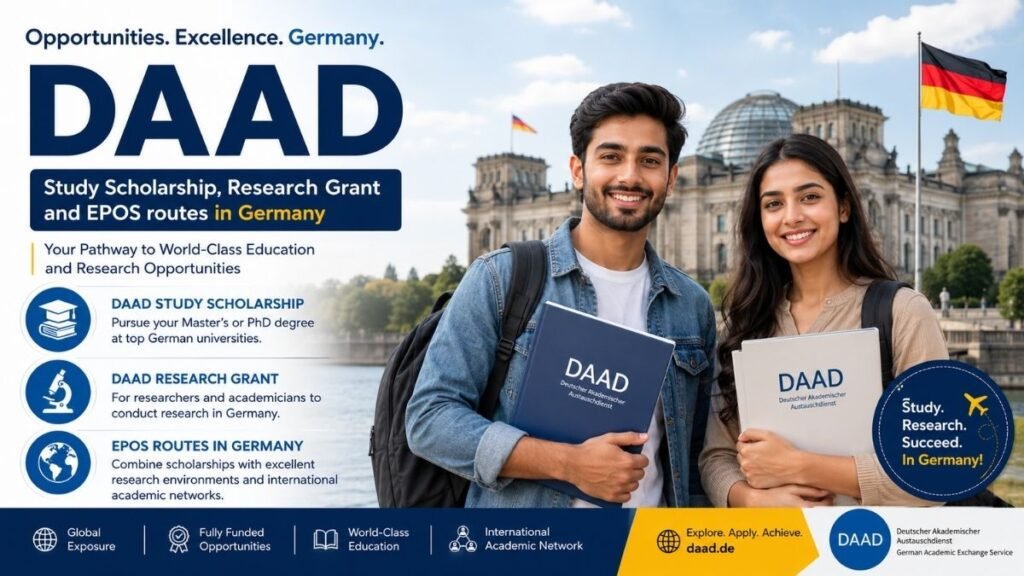
Pakistani students apply for DAAD funding through one of three routes, set by your level and your work background: a Study Scholarship for a Master’s, a Research Grant for a PhD, or EPOS for a development-related Master’s after at least two years of work.
DAAD Study Scholarships: a fully funded Master’s
DAAD Study Scholarships fund a full Master’s at a German public university for graduates of any academic discipline.
⚫ Level: Master’s, a full degree of 10 to 24 months
⚫ Funder: German Federal Foreign Office
⚫ Stipend: 992 euros per month, plus insurance, a travel allowance, and a 460 euro yearly study allowance
⚫ Suits you if: you hold a strong Bachelor’s and want a taught Master’s in Germany
⚫ Window: applications run from 1 June to the stated deadline; the scholarship usually starts on 1 October
DAAD Research Grants: a funded PhD or research stay
DAAD Research Grants fund a doctorate or an early-postdoc research stay in Germany, once a German supervisor agrees to host your project.
⚫ Level: PhD and early postdoc
⚫ Funder: German Federal Foreign Office
⚫ Stipend: 1,400 euros per month (raised from 1,300 euros in February 2026), plus insurance, travel and a research allowance
⚫ Suits you if: you have a relevant Master’s, a research project, and a German host institution
Note: the short research-grant variant is not open to you if your entire doctorate sits at a German university; full-doctorate variants are listed separately
DAAD Research Grants: a funded PhD or research stay
EPOS funds a development-related Master’s, and in rare cases a PhD, for professionals who have worked for at least two years after their first degree.
⚫ Level: Master’s, rarely PhD, at selected courses only
⚫ Funder: the BMZ, German Federal Ministry for Economic Cooperation and Development
⚫ Stipend: 992 euros per month for a Master’s, 1,400 euros for a doctorate, plus insurance and travel
⚫ Suits you if: you work in a development-related field such as public policy, public health, water management, renewable energy or economics, and plan to apply your training back in Pakistan
⚫ Apply route: to your chosen EPOS course or courses, up to three, not to DAAD directly
One more route to know:
The Helmut-Schmidt-Programme (Public Policy and Good Governance) funds a Master’s for future leaders in public policy, law, economics and administration, with a deadline of 31 July 2026 for the current cycle. If that is your field, check it in the DAAD database before you choose.
Who can apply, and what each route asks for
Every DAAD route sets its own bar, but all three expect a strong academic record and language proof in English or German.
Yes. Pakistani nationals can apply for all three routes. For EPOS you also need to be from a country on the DAAD developing-country list, which includes Pakistan, and to be working in a development-related role.
This depends on the route. A Study Scholarship needs a completed Bachelor’s with an above-average record, usually the top third of your class. A Research Grant needs a relevant Master’s, and for a doctorate a start date inside the recency window set in the Call. EPOS asks for a Bachelor’s of normally four years with far above average results, plus at least two years of related work after that degree.
Language proof is set by your programme, not by one fixed DAAD rule. English-taught courses usually ask for IELTS in the 6.0 to 6.5 range or an equivalent. German-taught courses ask for a German certificate such as TestDaF. A few programmes accept a medium-of-instruction letter instead of IELTS, so a route without IELTS does exist for some courses. Confirm the exact rule on your chosen programme’s page before you apply.
Study Scholarships and Research Grants are open to all academic disciplines. EPOS covers only its listed development-related courses, such as public policy, public health, water management, renewable energy and development economics. If you studied human medicine, veterinary medicine or dentistry, the Research Grant route adds extra rules, so read the Call for those fields with care.
DAAD does not publish a fixed age limit for these scholarships. It uses recency windows instead: a doctorate started no more than three years before the deadline, a postdoc within four years of finishing the PhD, and a degree-recency window for the Master’s route. Check the exact window in your route’s current Call rather than relying on an age number.
Through the DAAD Portal for a Study Scholarship or Research Grant, and through your chosen course for EPOS. The next section sets out both routes step by step.
How you apply: direct to DAAD, or through the university
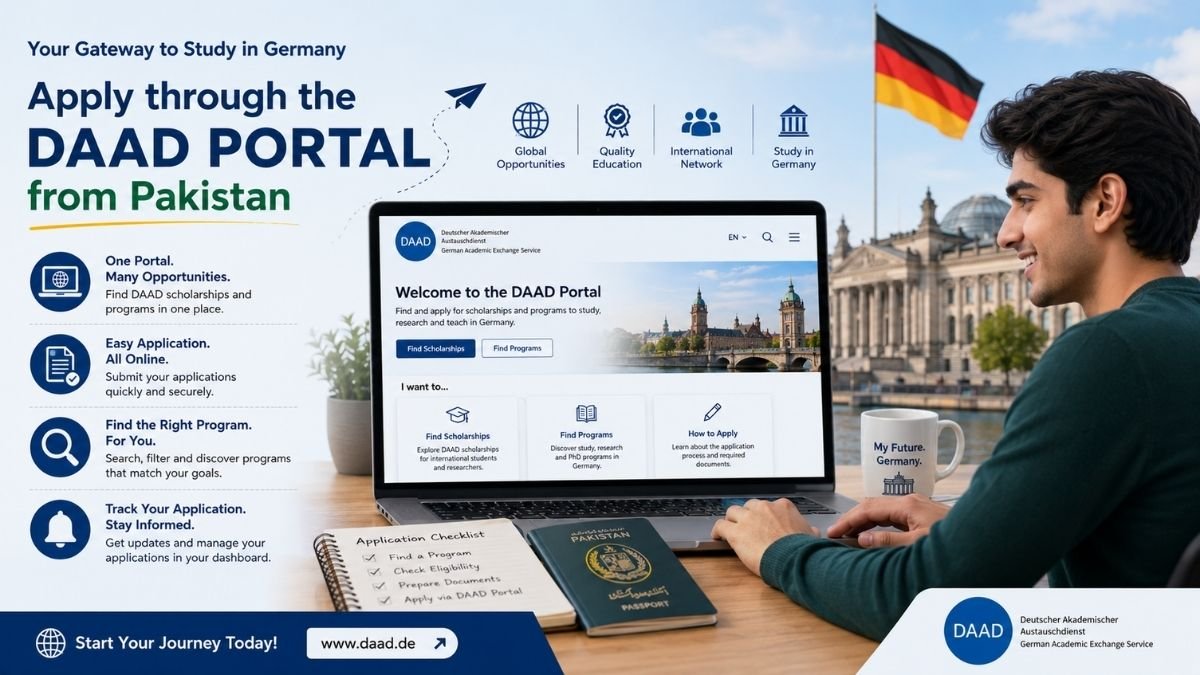
DAAD has no national sending-agency gate for Pakistan: you apply directly through the DAAD Portal for a Study Scholarship or Research Grant, and through your chosen university for EPOS.
Direct to DAAD (Study Scholarships and Research Grants)
⚫ Register on the DAAD Portal at meindaad.de.
⚫ Find your programme in the DAAD scholarship database at funding-guide.de, then open the “Submit application” tab, which appears only during the application window.
⚫ For a Master’s, you usually also apply separately to the German university. A DAAD application does not enrol you in the degree.
⚫ For a PhD, get your German supervisor’s written agreement to host the project before you apply.
Through the university (EPOS)
⚫ Pick up to three EPOS courses from the current brochure.
⚫ Send your EPOS application and documents to the course or university, not to DAAD. Applications sent straight to DAAD are not forwarded.
⚫ The university shortlists and recommends candidates to DAAD for funding.
The DAAD Information Centre Islamabad is a help desk, not a gate. It gives free guidance, runs orientation sessions, and has worked with the HEC for years. Your application still goes through the DAAD Portal or your chosen university, never through the Centre. This is different from the Hungary route, which runs through the HEC two-portal system, and from the Italy route, which needs university admission first. For DAAD, the portal or the university is your way in.
Official sources:
The documents you submit
DAAD asks for the same core paperwork on every route, then adds a few route-specific items for a PhD or for EPOS. This list is what you upload, separate from who can apply, which the Eligibility section covers.
Every route (Study Scholarship, Research Grant, EPOS)
1
Completed application form
2
CV in the europass tabular format, in reverse chronological order with no unexplained gaps
3
Letter of motivation
4
Degree certificates and transcripts of records showing your individual grades
5
A language certificate in English or German, as your programme requires
Extra for a Research Grant (PhD)
1
A research proposal, normally up to 10 pages
2
A separate time plan for the research stay, uploaded as its own document
3
Your German host supervisor’s written agreement to support the project
4
One recent letter of recommendation on a DAAD form from your thesis supervisor
Extra for EPOS
1
The EPOS application form
2
One letter of motivation that you send in the same form to every course you choose, with your order of priority stated if you pick more than one
3
A recommendation letter from your current employer on official letterhead, with signature, stamp and a current date
4
Certificates of employment proving at least two years of relevant work after your Bachelor’s
For a Study Scholarship, you generate the recommendation form inside the DAAD Portal during the application window, then send it to a university teacher to complete and return for upload.
What DAAD pays, and what it does not
DAAD pays a monthly living stipend in euros, plus insurance and a travel allowance, but it does not pay tuition, because German public universities charge none.
Covered
⚫ Monthly living stipend: 992 euros for a Master’s; 1,400 euros for a PhD or research stay; for EPOS, 992 euros for a Master’s and 1,400 euros for a doctorate
⚫ Contributions towards health, accident and personal liability insurance
⚫ A flat-rate travel allowance
⚫ A study allowance of 460 euros a year on the Study Scholarship, or a research allowance on the Research Grant
⚫ Possible extras once funding starts, applied for separately: a monthly rent subsidy, a monthly allowance for accompanying family, language course support, and support in case of disability or chronic illness
Not covered
⚫ Tuition fees, since German public universities are tuition-free and DAAD does not pay tuition
⚫ The full cost of living in an expensive city, which the stipend may not stretch to cover
⚫ Language certificate fees, which DAAD does not reimburse
DAAD’s own honest note: the stipend will not always cover all living costs, especially in university towns with high rents, so you may need to add some of your own funds. Plan your budget on that basis.
DAAD sets and pays everything in euros, so the euro figure is the one that matters. Any rupee conversion is indicative only, the rupee-euro rate moves, so reconfirm a current figure with MTZ before you commit to a budget. If you want background on living costs, see studying in Germany.
Applying step by step from Pakistan
You apply online for a Study Scholarship or Research Grant through the DAAD Portal, and through your chosen course for EPOS, so your first job is to fix your route and find its live Call.
step-1 →
Choose your route and open the live Call.
Decide between a Study Scholarship, a Research Grant or EPOS, then find that programme in the DAAD scholarship database at funding-guide.de. Study Scholarship applications run from 1 June to the stated deadline, and DAAD updates deadlines each year in the second quarter, with most falling between July and November for an October start. These are annual patterns, so MTZ confirms the live dates for your route before you build anything.
step-2 →
Line up what your route needs first.
For a Master’s, shortlist the German programmes you want and check each one’s language rule. For a PhD, write to potential supervisors and secure a German host’s agreement. For EPOS, shortlist up to three courses from the current brochure.
step-3 →
Register and apply through the right channel.
For a Study Scholarship or Research Grant, register on the DAAD Portal at meindaad.de and submit through the “Submit application” tab, which shows only during the window. For EPOS, send your application to your chosen course or university, not to DAAD, because applications sent straight to DAAD are not forwarded.
step-4 →
Request your recommendation early.
Generate the recommendation form inside the portal during the application window, then give your referee enough time to complete and return it before the deadline.
step-5
After selection, enrol and apply for your visa.
Once you are selected, complete enrolment at the German university, then apply for your Germany student visa from Pakistan. Funding usually begins on 1 October.
How MTZ helps you build a competitive application
MTZ helps you pick the right DAAD route, build an application that competes, and prepare your visa, while the funder alone decides the award.
We start with a free assessment of your degree, grades, work history and language level, then tell you honestly which DAAD route fits and how strong your case looks. If your profile is not yet competitive, we say so, and we show you what to strengthen first. Begin with the free scholarship profile assessment at mtzvisas.com/scholarship-eligibility/.
Once your route is clear, we shortlist German programmes or EPOS courses that match your field and your grades, and we flag the language rule for each one, so a hidden requirement does not stop you late in the process.
We help you shape your CV in the europass format, draft a letter of motivation that answers what DAAD actually assesses, and organise your transcripts, recommendation, and, for a PhD, your research proposal and time plan.
We take you through registering on the DAAD Portal, or the EPOS course route, and we check your file against the Call before you submit, so nothing is missing on deadline day.
After you are selected, we guide your enrolment and your Germany student visa from Pakistan, including the APS certificate and blocked-account steps, through to departure.
What MTZ cannot promise
MTZ does not award or guarantee any DAAD scholarship: DAAD selects, and selection is competitive.
Read these limits before you apply.
MTZ does not award, influence or guarantee any DAAD scholarship. DAAD and its selection committees decide every outcome.
Selection is merit-based and competitive. A strong profile raises your odds; it does not secure a place.
DAAD sets every figure, deadline and rule, and can change them. We confirm the live Call for you, but the official source is the final word.
• DAAD does not pay tuition, and the stipend may not cover your full living costs in an expensive city
We cannot speed up, bypass or fix any part of the DAAD or visa process. Anyone who promises that is not telling you the truth.
Any fee you pay MTZ is for guidance and application support only, never for a scholarship outcome.
Study Scholarship vs Research Grant vs EPOS
The three DAAD routes differ most on your level and your work history: a Study Scholarship suits a fresh graduate, a Research Grant suits a researcher with a German host, and EPOS suits a professional with at least two years of work.
| Point | DAAD Study Scholarship | DAAD Research Grant | EPOS |
|---|---|---|---|
| Level | Master’s | PhD or early postdoc | Master’s, rarely PhD |
| Who it suits | recent graduates, any discipline | researchers with a Master’s and a German host | working professionals, development fields |
| Monthly stipend | 992 euros | 1,400 euros | 992 euros (Master’s) |
| Work experience | not required | not required | at least two years required |
| How you apply | DAAD Portal, direct | DAAD Portal, after host agrees | through your chosen course |
| Deadline pattern | July to November | often around November | per course, EPOS brochure |
If you want a Master’s funded across two or more European countries rather than Germany alone, compare the Erasmus Mundus scholarships route as well.
DAAD scholarship questions Pakistani families ask
These are the questions Pakistani families ask most about the DAAD scholarship, with answers verified at official DAAD sources. The wording below is the locked source for the FAQPage schema (SF2) and must match it word for word.
Yes, in practice. DAAD pays a monthly living stipend, contributions to insurance, and a travel allowance, and German public universities charge no tuition. DAAD does note that the stipend may not cover all living costs in an expensive city, so budget a small top-up of your own.
No. For DAAD Study Scholarships and Research Grants you apply directly through the DAAD Portal at meindaad.de, with no HEC nomination step. EPOS goes through your chosen university. The DAAD Information Centre Islamabad gives free guidance but is not an application gate. A separate HEC-DAAD cooperation exists for some joint PhD lines, but the three main routes are direct.
It is 992 euros a month for a Master’s and 1,400 euros a month for a PhD or research stay. The PhD rate rose from 1,300 to 1,400 euros in February 2026. EPOS pays 992 euros for a Master’s and 1,400 euros for a doctorate, plus insurance and travel on every route.
No, and it does not need to. German public universities charge no tuition fees, so DAAD funds your living costs through a monthly stipend rather than paying tuition. Language certificate fees are not reimbursed.
Sometimes. Language proof is set by your programme, not by one fixed DAAD rule. English-taught courses usually ask for IELTS 6.0 to 6.5 or an equivalent, and German-taught courses ask for a German certificate. A few programmes accept a medium-of-instruction letter, so a route without IELTS does exist for some courses. Check your programme’s page before you apply.
The Study Scholarship is for recent graduates of any discipline and needs no work experience. EPOS is for working professionals in development-related fields with at least two years of work after their first degree. You apply for the Study Scholarship through the DAAD Portal, and for EPOS through your chosen course.
Only for EPOS, which needs at least two years of related work after your Bachelor’s. The Study Scholarship and the Research Grant do not require work experience; your academic and research record carries those applications.
No. DAAD publishes no fixed age limit for these scholarships. It uses recency windows instead, such as a doctorate started no more than three years before the deadline, or a postdoc within four years of finishing the PhD. Check the exact window in your route’s current Call rather than relying on an age number.
It depends on the route. For a Master’s Study Scholarship you usually apply to the German university separately as well, since a DAAD application does not enrol you. For a PhD you need a German supervisor’s written agreement first. For EPOS you apply to the course itself.
Deadlines vary by route and are updated each year in the second quarter, with most falling between July and November for an October start. Study Scholarship applications open from 1 June. The Helmut-Schmidt Public Policy and Good Governance deadline is 31 July 2026. Confirm your route’s live date before you apply, as cycles open and close annually.
Yes, for postgraduate or PhD study, not for an undergraduate MBBS. DAAD does not fund a basic medical degree. Medical graduates can apply for a Master’s, a research-based PhD, or a relevant EPOS public-health course, though human medicine carries extra rules on the Research Grant route.
Rarely. DAAD mainly funds Master’s, PhD and research, not full Bachelor’s degrees. A school-leaver has very limited DAAD options, so a Master’s is the realistic entry point for most Pakistani applicants.
It matches your programme. A Study Scholarship runs 10 to 24 months for the standard length of your Master’s. A Research Grant’s length is set by the selection committee for your work plan. EPOS funds the full Master’s, usually up to 24 months.
No. MTZ does not award or guarantee any DAAD scholarship. DAAD selects, and the process is competitive. MTZ helps you choose the right route and build a strong application, and any fee you pay is for that support, never for an outcome.
Start your DAAD application with MTZ
Tell us your degree, your grades and your field, and we will tell you honestly which DAAD route fits and how strong your case looks. DAAD decides the award; we help you put forward your best application.
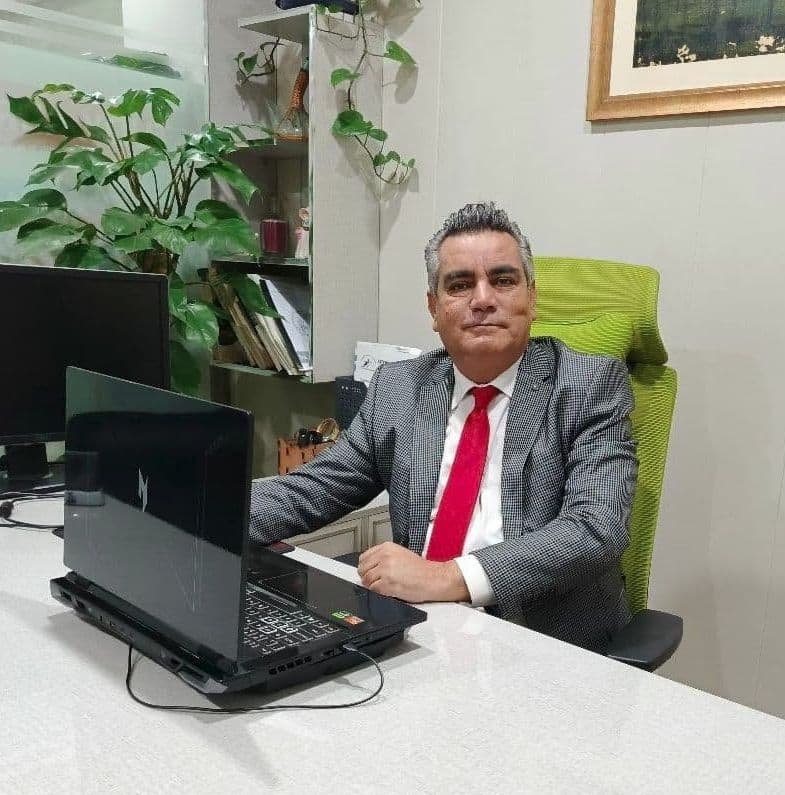
This page was written by Mubbashir Qureshi, CEO of MTZ Global Visa Consultants Pvt Ltd, drawing on 25+ years of personal experience guiding Pakistani students into study abroad and international education. MTZ Global Visa Consultants Pvt Ltd was established in 2025, is SECP registered and ISO 9001:2015 certified, and has offices in Islamabad and Lahore. The figures on this page were verified at official DAAD sources on 12 June 2026 and are reviewed before each intake. Spotted an error on this page? WhatsApp +92 315 155 5507. MTZ corrects verified errors within 24 hours