ISO 9001:2015 Certified

SECP Registered

British Council Certified Counsellors

25+ Years of CEO Experience
Spotted an error on this page? WhatsApp +92 315 155 5507. MTZ corrects verified errors within 24 hours.
quick answer
The Quick Answer for Pakistani Families
Australia scholarships for Pakistani students run mainly through two government routes. The Australia Awards Scholarship funds Master’s study for mid-career professionals, and you apply through the OASIS system. The Research Training Program (RTP) funds PhD and research Master’s degrees, and you apply directly to an Australian university. Both cover full tuition and living costs. MTZ helps you assess your profile and apply, but does not award or guarantee any scholarship.
Australia Scholarships at a Glance
Here are the verified essentials for both Australian government routes, so you can see at a glance which one fits your level and profile.
Funded by
the Australian Government. Australia Awards is run by the Department of Foreign Affairs and Trade (DFAT); the Research Training Program is run by the Department of Education.
Routes covered
Australia Awards Scholarship, and the Australian Government Research Training Program (RTP).
Study levels
Australia Awards for Pakistan funds Master’s level study only. RTP funds a PhD or a research Master’s. Neither route is a government-funded undergraduate scholarship.
Who each route suits
Australia Awards suits mid-career professionals in priority development fields. RTP suits research candidates who can secure a supervisor and an admission offer at an Australian university.
How you apply
Australia Awards through the online OASIS system. RTP directly to the postgraduate research office of your chosen Australian university.
English requirement
Australia Awards needs IELTS Academic 6.5 with no band below 6.0, or TOEFL iBT 84, or PTE Academic 58. RTP English requirements are set by each university.
What it covers
full tuition, a living allowance, health cover, and further allowances. Australia Awards also covers return airfare and a one-off establishment allowance.
Age
the Australia Awards Pakistan profile sets a maximum of 45 years at the time you submit your application. RTP has no national age limit; any limit is set by the university.
Return rule
Australia Awards scholars sign a contract to return to Pakistan for at least two years after study. RTP carries no return obligation.
Cost to apply
nothing. Australia Awards never asks applicants for money or bank details.
Australia Awards status (12 June 2026)
applications for the latest intake are closed and reopen in early 2027. The annual window runs about February to 30 April, for study the following year. RTP deadlines are set per university and per round.
The Two Australia Scholarship Routes
Australia scholarships for Pakistani students sit in two separate government programmes, and which one applies to you depends entirely on the level you want to study. Read both, then use the decision block below to place yourself.

Australia Awards Scholarships
The Australia Awards Scholarship is funded by the Australian Government through the Department of Foreign Affairs and Trade, and for Pakistan it funds Master’s level study only. It targets mid-career professionals working in priority development sectors, with study areas reviewed by the governments of Australia and Pakistan each cycle, currently the empowerment of women and girls, water security, agriculture, energy, governance and inclusive economic development. Selection weighs your potential to drive development in Pakistan, not grades alone, and the programme is managed in South Asia by Palladium on behalf of the Australian Government, with an Australia Awards office at the Australian High Commission in Islamabad. As of 12 June 2026 the latest intake is closed and applications reopen in early 2027.
Australian Government Research Training Program
The Research Training Program (RTP) is funded by the Australian Government through the Department of Education, and it funds a research degree, meaning a PhD or a research Master’s, at an eligible Australian university. The money reaches you through the university, not through a central office, because the government distributes RTP funding as annual block grants to more than 40 eligible universities, which then award places to their strongest research candidates. Some universities advertise their RTP allocation under their own scholarship name, but the funding source is the same federal RTP grant. There is no single national deadline; each university runs its own selection rounds.
Who Is Eligible
Eligibility differs sharply between the two routes, so check yourself against the route you are aiming for rather than assuming one set of rules covers both. Australia Awards carries strict Pakistan-specific conditions; RTP eligibility is set by each university.
For Australia Awards you must be a Pakistani citizen currently residing in Pakistan and applying from Pakistan, and you must not hold Australian citizenship or permanent residency or be applying to live in Australia permanently. For RTP, your nationality is not a barrier; the programme is open to international students of any country, including Pakistan.
Australia Awards for Pakistan funds Master’s level study only, as stated in the official Pakistan country profile. RTP funds a Research Doctorate (PhD) or a Research Master’s, together called a Higher Degree by Research. Neither route funds undergraduate study, and RTP does not fund coursework-only Master’s degrees.
MIS accepts an IELTS band 6.0, or a TOEFL paper-based score of 550 or its equivalent, or a previous degree taught in English confirmed by an official declaration from that university. MTCP accepts an IELTS overall 6.0, or a TOEFL iBT of 60, or a previous degree taught in English. If your last degree was taught in English, you may apply without sitting IELTS, using the medium-of-instruction route.
Australia Awards requires you to have completed 16 years of education and to hold five years of relevant work experience in Pakistan, with selection assessing your academic competence alongside your leadership and development potential. RTP is awarded on research merit; universities look at your academic record, your research proposal, and whether a supervisor will take you on, with publications counting at research-intensive universities.
Australia Awards requires IELTS Academic 6.5 with no band below 6.0, or TOEFL iBT 84 with at least 21 in each sub-test, or PTE Academic 58 with no communicative skill below 50, valid as at 1 January of the application year. Applicants with a disability may apply with IELTS 6.0, no band below 5.0, then re-sit to the standard score before taking up the award. RTP English requirements are set by each university, so confirm the exact score on the university’s own page.
The official Australia Awards Pakistan country profile sets a maximum of 45 years of age at the time you submit your application. Confirm this against the current cycle’s profile when it republishes, as the figure is reviewed each intake. RTP has no national age limit; any age condition is set by the individual university.
Australia Awards funds study only in the priority development sectors agreed by the two governments, currently the empowerment of women and girls, water security, agriculture, energy, governance and inclusive economic development, so a programme outside these areas will not be funded. RTP has no fixed field list; funding follows the research project and the supervisor’s discipline.
Awards or RTP: Which Route Is Yours
The single biggest mistake Pakistani applicants make is applying through the wrong route, because the two are applied for in completely different ways and you cannot move between them mid-application. Place yourself first, then follow the matching method below.
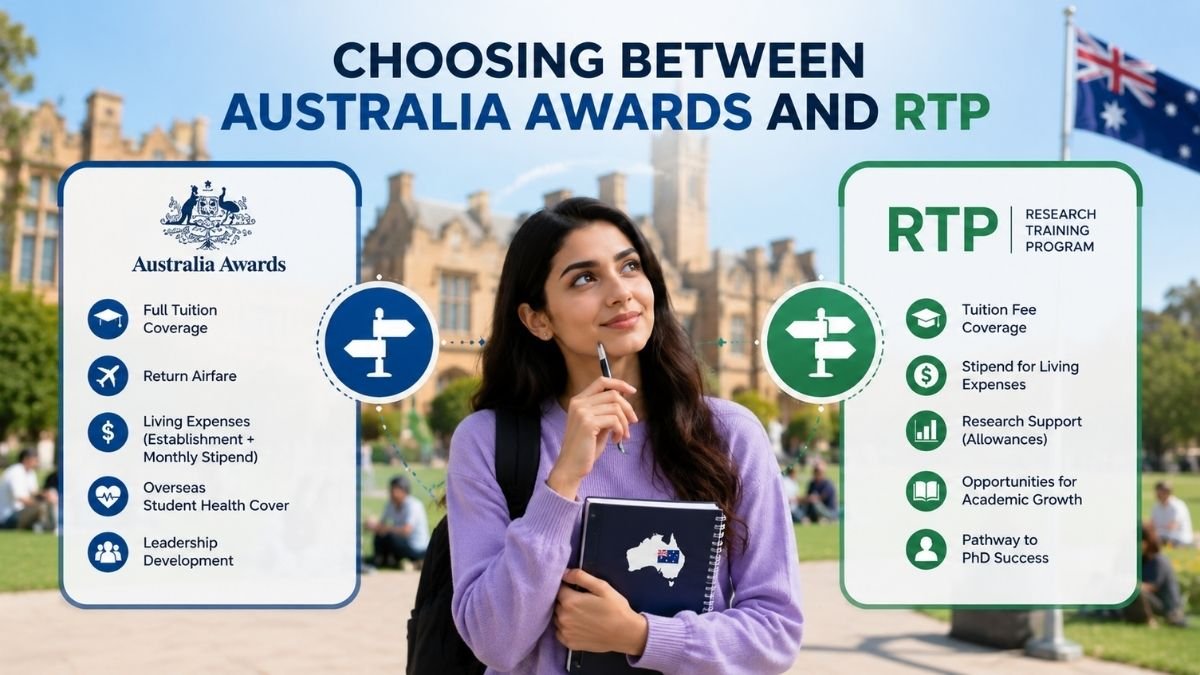
Australia Awards route, apply through OASIS
You apply directly to the Australian Government through the online OASIS system, which is the Online Australia Awards Scholarships Information System. There is no Higher Education Commission step and no third-party portal. You submit your documents in OASIS, eligible applicants are shortlisted, and shortlisted candidates attend an interview assessed on academic competence, development contribution, and leadership. Australia Awards never asks applicants for money or bank details, so treat any such request as a scam. The window runs about February to 30 April for study the following year, and as of 12 June 2026 it is closed until early 2027.
If you are a working professional who wants a Master’s in a development field and can commit to returning to Pakistan for two years, Australia Awards is your route. If you want a PhD or a research Master’s and you can find an academic supervisor willing to take your project, RTP is your route. If you want an undergraduate degree, neither government route applies, and the honest-limits section below explains what that means for your family.
RTP route, apply through the university
You apply directly to the postgraduate research office of the Australian university you want to study at, not to any central scholarship body. The practical order matters: first you secure a research supervisor and a place in a research degree, then the university considers you for an RTP scholarship through its own competitive ranking. Each university sets its own rounds and deadlines, so you work to the calendar of the specific university. Contact the university’s research office or read its RTP policy for the exact steps.
Documents You’ll Need
The document set differs by route, so prepare against the route you are applying to rather than gathering everything blindly. This block lists what you submit; who is eligible to submit it is covered in the eligibility section above.
Australia Awards (submitted in OASIS):
⚫ Completed Development Impact Plan, on the template published on the Australia Awards Pakistan website
⚫ Degree certificates for your Bachelor’s, and any Master’s, with both sides copied
⚫ Academic transcripts for your Bachelor’s, and any Master’s, with both sides copied
⚫ Proof of English: your IELTS, TOEFL or PTE result, valid as at 1 January of the application year
⚫ Two academic referee reports for a Master’s by Research, or one for a Master’s by Coursework, on the official template
⚫ One employment referee report, on the same template
⚫ A No Objection Certificate, for public-sector applicants only
RTP (submitted to the university):
⚫ Academic transcripts and degree certificates
⚫ An English test result that meets the university’s stated score
⚫ A research proposal aligned to a research area at the university
⚫ Evidence of a supervisor willing to take your project
⚫ A CV listing research outputs or publications where the university asks for them
The RTP list is set by each university, so treat the points above as the typical set and confirm the exact requirements on your chosen university’s research-office page. MTZ never invents a document requirement for you.
What Each Route Covers
Both Australian government routes cover full tuition and your living costs, but the extras differ, and each route leaves some things to you. Figures are stated in Australian dollars, the scheme currency.
Australia Awards, covered (official DFAT benefit list for Pakistan):
⚫ Full tuition fees for your Master’s programme
⚫ A contribution to living expenses
⚫ Return air travel between Pakistan and Australia
⚫ A one-off establishment allowance on arrival
⚫ Overseas Student Health Cover for the full scholarship period
⚫ An Introductory Academic Program and supplementary academic support
⚫ A fieldwork allowance for research students and for a coursework Master’s with compulsory fieldwork
DFAT does not publish a single fixed stipend figure in the Pakistan profile, so the living-cost amount is set by the programme rather than quoted here as a number.
RTP, covered (three official components, Department of Education):
⚫ RTP Fees Offset: covers 100 percent of your tuition for the minimum course duration, up to 4 years for a PhD and up to 2 years for a research Master’s. International research tuition commonly runs AUD 28,000 to AUD 50,000 per year, so this offset is worth a large sum across a full degree.
⚫ RTP Stipend: a tax-free living allowance, set yearly and topped up by some universities. Verified 2026 examples: Flinders University AUD 36,061 per year, the University of the Sunshine Coast AUD 38,000 per year, and the University of Sydney up to AUD 42,754 per year. The exact figure depends on the university.
⚫ RTP Allowances: support for relocation, thesis printing, and health-cover costs, including for the recipient’s dependents at many universities.
Not covered, either route:
⚫ A government-funded undergraduate degree (neither route funds Bachelor’s study)
⚫ A coursework-only Master’s under RTP
⚫ Any cost above the stated allowances, which is why you budget on the conservative side
Rupee figures are indicative only. Australian dollar amounts move against the rupee over a multi-year degree, so plan on a conservative rate and WhatsApp MTZ Islamabad or Lahore for the current rupee breakdown before making any financial decision. MTZ does not publish a fixed rupee table because the rate changes.
How to Apply, Step by Step
The application path depends on your route, so follow the Australia Awards steps if you are a Master’s professional, or the RTP steps if you are a research candidate. These steps cover the process; the documents you submit are listed in the section above.
Australia Awards:
step-1 →
Confirm you fit the priority fields and the Pakistan conditions. Check that your intended Master’s sits in a current priority development sector and that you meet the 16-years-of-education, five-years-of-work-experience and age conditions before you start.
step-2 →
Sit your English test early. Book IELTS, TOEFL or PTE so your score is valid as at 1 January of the application year, because a lapsed or low score ends the application.
step-3 →
Build your Development Impact Plan. This is the heart of the Australia Awards application, where you set out how your study will contribute to development in Pakistan. Give it the most time.
step-4 →
Apply in OASIS within the window. You submit directly to the Australian Government through the OASIS system, with no Higher Education Commission step. The annual window runs about February to 30 April for study the following year.
step-5
Prepare for shortlisting and interview. Eligible applicants are shortlisted and interviewed on academic competence, development contribution and leadership. Selected scholars sign a contract that includes returning to Pakistan for at least two years after study.
RTP:
step-1 →
Shortlist universities and supervisors. Identify Australian universities with research strength in your area and a potential supervisor whose work fits your project.
step-2 →
Contact a supervisor and shape your proposal. Email a supervisor with a focused proposal; their willingness to take you is the practical gate for RTP funding.
step-3 →
Apply for admission to the research degree. Submit your application to the university’s research office, since RTP funding flows through the university, not a central body.
step-4 →
Apply for the RTP scholarship in the same university process. The university ranks research candidates competitively for RTP places. Meet each university’s own round dates, as there is no single national deadline.
step-5
Accept your offer and arrange your student visa. Once a university offers you an RTP place, you accept and move to the student visa stage, where MTZ supports you.
Application windows shift each cycle, and as of 12 June 2026 the Australia Awards intake is closed and reopens in early 2027. MTZ confirms the live dates for your cycle before you start, so you never work from a stale calendar.
How MTZ Helps You Apply
MTZ works on the parts of an Australian application that decide the outcome: matching you to the right route, building documents that hold up, and supporting your visa. MTZ does not award, influence, or guarantee any scholarship; the funders decide.
MTZ reads your profile against both routes honestly and tells you which one you have a real chance at, or tells you plainly if neither fits yet. For Australia Awards that means checking your years of education, work experience and field against the priority sectors; for RTP it means judging whether your research record and degree class are competitive.
MTZ helps you shortlist the right targets: a Master’s in a funded development field for Australia Awards, or universities and supervisors whose research matches your project for RTP. Picking targets you can actually win is half the work.
MTZ helps you build the documents that carry the most weight, the Development Impact Plan for Australia Awards and the research proposal and CV for RTP, and checks your transcripts, referee reports and English score against the stated requirements. MTZ never invents a document or a figure on your behalf.
MTZ guides you through submitting in OASIS for Australia Awards, or through the university’s research-office process for RTP, and helps you track each cycle’s live dates so you do not miss a window or a university round.
Once you hold an offer, MTZ supports your Australian student visa: the paperwork, the financial and health-cover evidence, and the timeline, so the final stage does not undo months of work.
Start with the free scholarship eligibility assessment:
The Honest Limits You Should Know
Before you spend months on an Australian application, read the limits plainly, because knowing them now saves you from a wasted cycle. MTZ would rather tell you the hard truth than sell you a false hope.
Read these limits before you apply.
Neither government route funds an undergraduate degree. If your child is finishing school and wants a fully funded Bachelor’s in Australia, these routes do not apply, and a self-funded place or a university-specific undergraduate award is a separate path.
Australia Awards is not a general merit scholarship. It funds mid-career professionals in set development fields who can return to Pakistan for two years, and it weighs development potential over grades. A strong transcript alone will not win it.
RTP is not won by applying to a scholarship office. It is won by securing a supervisor and an admission offer first, and many strong applicants are turned down simply because no supervisor had capacity.
There is no MBBS or clinical-medicine funding route here. Australia Awards is development-sector Master’s study and RTP is research, so neither funds a medical degree. For medical study, see MTZ’s MBBS guidance instead.
Both routes are highly competitive and have closed and open windows. As of 12 June 2026 the Australia Awards intake is closed and reopens in early 2027. Applying outside the window is not possible.
MTZ does not award or guarantee any scholarship. Selection rests entirely with the Australian Government and the universities. MTZ improves how you apply; it cannot decide the result.
Australia Awards vs RTP, Side by Side
The two routes solve different problems, so compare them on the points that decide your choice: level, who applies, how you apply, and what you owe afterwards. The Australia Awards column carries the lighter emphasis tint as the most-searched route.
| Feature | Australia Awards | RTP |
|---|---|---|
| Funded by | DFAT (Australian Government) | Department of Education (Australian Government), via universities |
| Study level | Master’s only (for Pakistan) | PhD or research Master’s |
| Best suited to | Mid-career professionals in development fields | Research candidates with a supervisor |
| How you apply | Directly to the Government through OASIS | Directly to the university’s research office |
| Selection basis | Development potential, leadership, academics | Research merit, proposal, supervisor fit |
| English requirement | IELTS 6.5 (no band below 6.0), or equivalent | Set by each university |
| Tuition | Fully covered | Fully covered by RTP Fees Offset |
| Living allowance | Contribution to living expenses (set by programme) | RTP Stipend, about AUD 36,000 to 42,754 per year, varies by university |
| Airfare and establishment | Return airfare plus one-off establishment allowance | Not standard; relocation allowance at many universities |
| Age limit | Maximum 45 at application (Pakistan profile) | No national limit; set by university |
| Return obligation | Return to Pakistan for at least 2 years | None |
| Application window | About February to 30 April yearly; closed until early 2027 | Per university and per round |
For a broader picture of every funded country option, see the MTZ global scholarships hub:
Questions Pakistani Families Ask About Australia Scholarships
These are the questions Pakistani applicants and parents ask most, answered plainly with verified facts. This wording is the locked source for the FAQ schema, so it matches the schema word for word.
Australia Awards is currently closed and reopens in early 2027. The annual window runs about February to 30 April for study the following year, and as of 12 June 2026 you cannot apply until the next cycle opens. RTP has no single national window; each Australian university runs its own rounds, so RTP applications may be open at one university while closed at another.
Australia Awards funds a Master’s for mid-career professionals and you apply to the Australian Government through OASIS. RTP funds a PhD or research Master’s and you apply directly to an Australian university. Australia Awards weighs development potential and carries a two-year return obligation; RTP is won on research merit and carries no return rule.
No. Australia Awards is free to apply for and never asks applicants for money or bank details. If anyone asks you to pay a fee or share bank details for an Australia Awards application, treat it as a scam and stop.
Yes for Australia Awards: you need IELTS Academic 6.5 with no band below 6.0, or TOEFL iBT 84, or PTE Academic 58, valid as at 1 January of the application year. For RTP, the English requirement is set by each university, so you confirm the exact score on your chosen university’s page.
Yes. The official Australia Awards Pakistan country profile sets a maximum of 45 years of age at the time you submit your application. Confirm this against the current cycle’s profile when it republishes, as the figure is reviewed each intake. RTP has no national age limit.
No. Neither Australia Awards nor RTP funds a Bachelor’s degree. Australia Awards for Pakistan funds Master’s study only, and RTP funds research degrees only. A self-funded place or a university-specific undergraduate award is a separate path outside these two government routes.
Yes. Australia Awards requires you to have completed 16 years of education and to hold five years of relevant work experience in Pakistan. It targets mid-career professionals, so a fresh graduate without that experience is not yet eligible. RTP does not require work experience.
For Australia Awards, yes: scholars sign a contract to return to Pakistan for at least two years after completing study, to contribute to development at home. RTP carries no return obligation, so a research graduate is free to stay or move under the normal visa rules.
You secure a research supervisor and an admission offer at an Australian university first, then the university considers you for an RTP place through its own competitive ranking. There is no central RTP application; the funding flows through the university. Contact the university’s postgraduate research office for its exact process and dates.
The RTP stipend is a tax-free living allowance set yearly and topped up by some universities. Verified 2026 examples are AUD 36,061 per year at Flinders University, AUD 38,000 at the University of the Sunshine Coast, and up to AUD 42,754 at the University of Sydney. The exact amount depends on the university you join.
Australia Awards funds study only in the priority development sectors agreed by the governments of Australia and Pakistan, currently the empowerment of women and girls, water security, agriculture, energy, governance and inclusive economic development. A Master’s outside these areas will not be funded, and the list is reviewed each cycle.
No. Australia Awards is development-sector Master’s study and RTP funds research degrees, so neither route funds an MBBS or clinical-medicine degree. If your family is researching medical study, MTZ’s MBBS guidance covers funded and self-funded medical routes separately.
No. Unlike some other government scholarships, Australia Awards has no Higher Education Commission step. You apply directly to the Australian Government through the online OASIS system. For RTP, you apply directly to the university, again with no Higher Education Commission step.
MTZ assesses your profile honestly, helps you match to the right route, and helps you build and submit a competitive application, then supports your student visa once you hold an offer. MTZ does not award, influence, or guarantee any scholarship. The Australian Government and the universities make every selection decision.
Start Your Australia Scholarship Application With MTZ
You do not have to work out the right route alone. Send MTZ your profile and get an honest read on whether Australia Awards or RTP fits you, and what to prepare before the next window opens.
Author: Mubbashir Qureshi, CEO, MTZ Global Visa Consultants Pvt Ltd. 25+ years personal experience guiding Pakistani students into study abroad and international education.
Last verified: 12 June 2026. Next review: 12 September 2026. Spotted an error on this page? WhatsApp +92 315 155 5507. MTZ corrects verified errors within 24 hours.